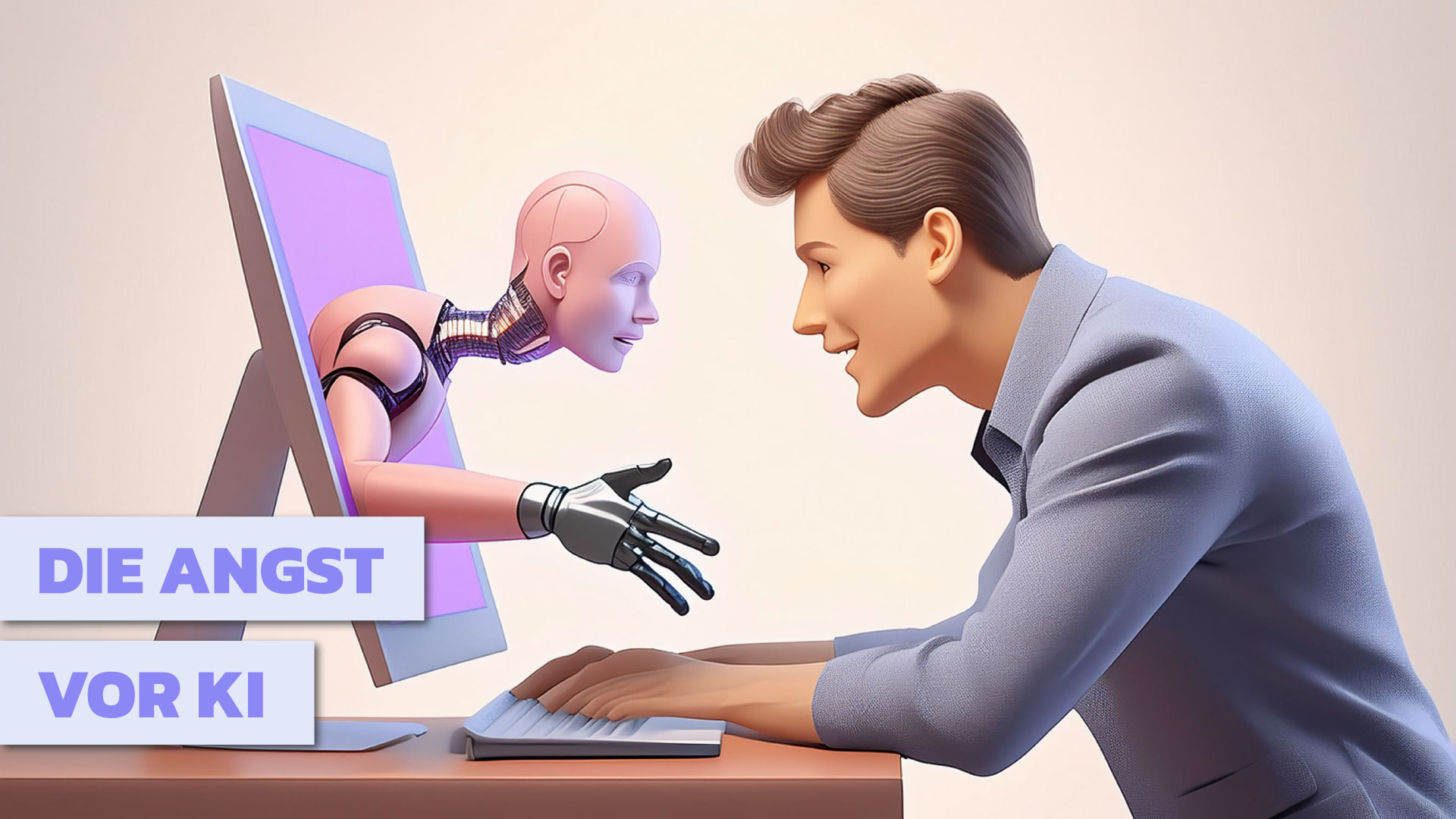
In our Splitblog today we take on a very current and much-discussed topic: the fear of artificial intelligence (AI). A topic suggestion from our developer Sören, who makes sure Splitbot can handle email too.
Where is the best place to start with a subject this sensitive? Perhaps with fear itself. Fear warns us of danger and helps us make quick decisions. In that sense it is extremely important and useful for the survival of the human species.
When we encounter the unknown, we often react with fear as well. A reflex that also serves to make us act quickly – to flee, for instance. But when fear takes over, it can seriously impair daily life. So it is worth looking more closely at the things that frighten us, and taking the terror out of them that way.
The picture of artificial intelligence that exists in many people's minds is – admittedly – a very threatening one. That picture is often shaped by old science fiction classics and is greatly exaggerated. The media do their part too, with reporting that is frequently one-sided and negative. The public consumes media in order to be warned of impending dangers – so it is no wonder that headlines often aim squarely at our fears. But if you look beyond the sensational headline and read the article itself, a completely different picture often emerges.
To get closer to the subject, there is one more important point to clarify: the term “intelligence”. The word derives from the Latin “intellegere” and means to recognise, to understand or to comprehend. William Stern defined intelligence as the ability to adapt to unfamiliar situations – a person's ability to find a solution even in a completely new situation.
That is precisely what, given the current state of technology, not a single AI system can do.
What looks to us like a spontaneous reaction, from a chatbot for instance, is in truth only a very fast retrieval and output of predetermined data. Apparent humour, creative ability or predictions rest solely on the statistically highest probability of a match that the system calculates for the solution. Conversely, that also means an AI cannot respond when it does not have enough data to solve a problem.
So what can we do with this insight in relation to our fears? Yes, AI systems can access far larger amounts of data far faster than most people. But will they become independently capable of acting and thinking any time soon? Definitely not.
Yes, AI systems will change our working world. Processes will speed up and information flows will change. In many cases the tasks of workers will change accordingly. There will have to be experts who can operate and use these systems. Time, then, to prepare for that and to engage intensively with the possibilities, rather than shutting ourselves off out of fear. Further training and learning new skills have always been part of professional and personal development.
Yes, it is absolutely right to voice concerns and to question new developments. Only that way can we make sure all relevant factors are considered as artificial intelligence is developed. Different perspectives are decisive for good outcomes. All the more important, then, not to leave the development of artificial intelligence to enormous corporations that often grant hardly any insight, but to help shape it actively and locally.