Category: News

  • The Splitblog in March – I spy with my little eye, and what I see is AI

    The Splitblog in March – I spy with my little eye, and what I see is AI

    The Splitblog in March – I spy with my little eye, and what I see is AI

    The AI boom continues, and for many people, AI still feels like a brand-new technology that has suddenly sprouted from the ground. This is reason enough for us to shed light on where AI has been accompanying us in our everyday lives (and for a very long time) without us even noticing.

    The smartphone camera

    While professional shots used to require high-quality equipment and a great deal of expertise, the perfect photo is now often achieved at the touch of a button. Many smartphones are not only equipped with high-quality cameras but have also often featured sophisticated AI technology for over a decade. It recognizes scenes, adjusts the focus, optimizes exposure, and helps turn our casual snapshots into vivid images.

    E-commerce

    Perhaps a bit more obvious, yet rarely actively perceived: purchase recommendations. Many online shopping providers rely on AI to analyze our preferences, purchasing behavior, and selections. Based on this, further product recommendations are generated to entice us to make additional purchases—and have been for more than 20 years.

    Agriculture

    AI has also long since found its way into agriculture. Soil conditions and plant growth are precisely analyzed to optimize crop yields and cultivation. It is also used in livestock farming, for example, in calculating the ideal feed quantity and composition.

    Video games

    Since the late 1990s, AI has become an indispensable part of video games. In particular, the behavior of so-called NPCs (Non-Player Characters) is frequently AI-controlled.

    Sports forecasts

    Not necessarily relevant to everyday life, but exciting for sports fans: match analyses and forecasts are also frequently created using AI tools. One of the better-known examples here is likely xGoals. For instance, xGoals is capable of calculating the probability of a goal being scored based on player positioning. In a professional soccer match, up to 3.6 million data points can be collected and used for match analysis. AI therefore has a significant impact on match tactics and training, but is also used for recruiting new athletes.

    Navigation systems

    Navigation systems have long done more than just calculate a route. AI has been used here for some time to incorporate fuel consumption and current traffic data. This allows modern navigation systems to reliably suggest the best route or determine alternatives in real time.

    AI is now ubiquitous and has long since arrived in our daily lives. It does no harm to take a look at it within your personal environment. And the next time your robot vacuum cleaner gets stuck in the carpet fringe, you can ask yourself with a wink whether the takeover of the world by AI is really as imminent as some suggest.


  • The Splitblog in February – Everything Companies Need to Know About the EU AI Act Now

    The Splitblog in February – Everything Companies Need to Know About the EU AI Act Now

    The Splitblog in February: Everything Companies Need to Know About the EU AI Act Now

    The EU AI Act has been in force since August 2024. A current draft bill for an implementing act has now been adopted. The Federal Network Agency (Bundesnetzagentur) is to serve as the central point of contact for monitoring the EU requirements on artificial intelligence.

    The EU AI Act is the first comprehensive legal framework for artificial intelligence worldwide. It is intended to promote trustworthy AI in Europe, minimise risks, and at the same time enable innovation. For companies, it is crucial to understand and implement the new requirements in order to avoid legal risks and secure competitive advantages.

    What is the EU AI Act?

    The EU AI Act is a framework that classifies AI systems according to their risk potential and defines corresponding regulatory requirements. The aim is to ensure safety, transparency, and compliance with fundamental rights when using AI.

    Risk-based approach and categorisation of AI systems

    The EU AI Act divides AI systems into four categories:

    Unacceptable risk (prohibited)

    Examples: Social scoring systems, manipulation of children, biometric categorisation based on sensitive characteristics.

    Regulation: These systems are prohibited in the EU.

    High risk

    Examples: AI in medical devices, transport systems, recruitment, law enforcement.

    Regulation: Strict requirements such as risk management, data governance, technical documentation, and human oversight.

    Limited risk

    Examples: Chatbots, deepfakes.

    Regulation: Transparency obligations, e.g. labelling AI-generated content.

    Low/no risk

    Examples: Spam filters, AI in video games.

    Regulation: No additional obligations, but general principles such as non-discrimination apply.

    Conformity requirements for high-risk AI systems

    Companies that use high-risk AI systems must meet the following requirements:

    • Risk management: Continuous risk assessment and mitigation.
    • Data governance: High-quality, representative, and error-free training data.
    • Technical documentation: Proof of conformity.
    • Logging: Automated recording of events for at least 10 years.
    • Transparency: Clear information about capabilities, limitations, and risks.
    • Human oversight: Mechanisms to control AI functions.
    • Certification: Third parties must confirm compliance with the regulations.
    • CE marking: Proof of conformity for the EU market.

    Steps for implementation and compliance

    • Determine the risk category

    Use tools such as the AI Act Compliance Checker to review the classification of your AI system.

    • Conduct risk assessments

    Identify potential harms and implement risk mitigation measures.

    • Create documentation

    Maintain technical documentation, training data, and compliance evidence.

    • Implement human oversight

    Ensure that AI systems are controlled and monitored by humans.

    • Meet transparency obligations

    Inform users about AI-generated content and system limitations.

    • Use a regulatory sandbox

    Test AI systems in controlled environments to ensure compliance.

    • Watch for updates

    The EU AI Act will be further refined, e.g. through simplified implementation rules.

    Implementation dates and penalties for non-compliance

    • February 2025: Prohibited practices and AI literacy obligations enter into force.
    • August 2025: Governance rules for General-Purpose AI (GPAI).
    • August 2027: Full application for high-risk AI systems.

    Penalties for non-compliance:

    • Up to €35 million or 7% of global turnover for breaches of prohibitions.
    • Up to €15 million or 3% of turnover for other breaches.
    • Lower penalties for SMEs.

    Conclusion: Why the EU AI Act matters

    The EU AI Act ensures that AI is developed safely, transparently, and in line with European values. Companies that implement the requirements early can avoid legal risks, strengthen consumer trust, and position themselves in the EU market. Compliance with the AI Act is not only a legal obligation, but also an opportunity to drive responsible AI innovation.

    For more information, please visit the official EU AI Act website.

    Note: This article was created with the help of AI.

  • The Splitblog in January – Bringing History to Life with AI

    The Splitblog in January – Bringing History to Life with AI

    The Splitblog in January – Bringing History to Life with AI

    The sometimes justified criticism of the use of AI does not stop. The media is full of headlines about deepfakes and misinformation. However, we don’t want to start the new year negatively, but rather dedicate ourselves to positive topics.

    AI, especially AI image generators, has been used for some time to visually recreate historical people and scenes. This primarily helps researchers to get a better picture of past events and deepen their research.

    AI in history lessons

    But also pupils can benefit from the use of AI in history lessons. The human brain demonstrably understands images better than words. A fact that regularly presents teachers with challenges. Most of us certainly remember boring lesson monologues, the content of which was forgotten at the latest with the break bell. History lessons in particular are difficult to make tangible, because the budget and time for regular visits to museums or other venues are limited. AI can at least partially remedy this. With its help, it becomes possible to bring historical moments, people and scenes into the present. Instead of verbal descriptions, for example of historical artifacts, AI image generators can realistically recreate these artifacts and thus stimulate the imagination. Historical scenes can be relived as video sequences. With the series “Deepfake Diaries”, ZDF has brought contemporary witnesses to life with the help of AI technology. This series impressively shows how a new form of history lessons can be created through the combination of historical recordings and modern AI technology.

    Opportunities and challenges

    Of course, tact and caution are also required here. Data protection concerns must be taken into account and AI-generated content must always be checked for its veracity. But here, too, there is an opportunity to turn risks into opportunities: Can pupils distinguish between fact and fiction? For example, do they find errors in videos or false statements in AI-generated contemporary witness reports? This would not only train historical knowledge, but also critical media use at the same time. Pupils could learn how to check information and how to use digital media responsibly. This is particularly important in a time when misinformation and manipulation are omnipresent.

    AI in other subjects

    But not only history lessons can benefit from the use of AI. In art lessons, for example, AI can transform landscape panoramas into vivid scenes. Or how about asking authors “personally” in German lessons what they wanted to express with their poems and works? Through the use of AI, pupils could enter into interactive conversations with historical figures and thus develop a deeper understanding of literature and contemporary history.

    More on the topic

    Instructions for pupils on how to chat with historical figures can be found here: https://www.kiraffe.de/materials/Lernpfade/historische-persoenlichkeiten.html . This is also possible, for example, with the app “Hello History – AI Chat”.

    Or to watch: https://www.zdf.de/dokus/terra-x-history-deepfake-diaries-100

    To read: https://hisgoespub.hypotheses.org/5676 , https://eisenbach-einst-und-jetzt.de/wenn-alte-fotos-lebendig-werden-ki-clips-aus-eisenbachs-geschichte , https://deutsches-schulportal.de/unterricht/zeitzeugen-als-hologramme-wie-digitale-loesungen-naehe-schaffen/

  • The Splitblog in December – Merry X-Mas

    The Splitblog in December – Merry X-Mas

    Merry X-Mas! The Splitblog in December

    What would December be without perfectly polished year-end reviews and Christmas greetings? Of course, we’re joining in. Because yes, we can all do without hackneyed phrases and oh-so-glorifying descriptions. But what is important is to occasionally look back, and December is simply predestined for that. So let’s go.

    Working in a startup sometimes feels like reaching for the stars. You stretch, higher and higher, strive to get just a little bit further, and in the end, it’s still not enough. Again. And what do you do then? Take a deep breath, gather your strength, and try again. Support is extremely important in this process.

    We were pleased to receive such support at the beginning of the year when our submitted project “Chatbot meets administration: Intelligent dialogue systems as a future solution for non-profit organizations” was approved by the Federal Ministry of Labor and Social Affairs as part of the Civic Innovation Platform. Together with the Kinderschutzbund Kreisverband Ostholstein e.V., the Landesverband der Kleingartenvereine Schleswig-Holsteins e.V., InMotion e.V. and the Ostsee-Holstein-Tourismus e.V., we are working on EVA – an AI-supported chatbot that is intended to make association work easier. EVA is now ready for testing and available as open source software. This cooperation helps us to take a broad spectrum of needs into account during development. We are very grateful for the time invested by the participating associations, the positive exchange and the feedback. The uncomplicated help from our external consultants from the Zukunftslabor Generative KI, from DSS IT Security and the Lauprecht law firm is also worth its weight in gold.

    We also successfully concluded some important contracts this year, which have shown us that we are on the right track and that our idea meets a real need.

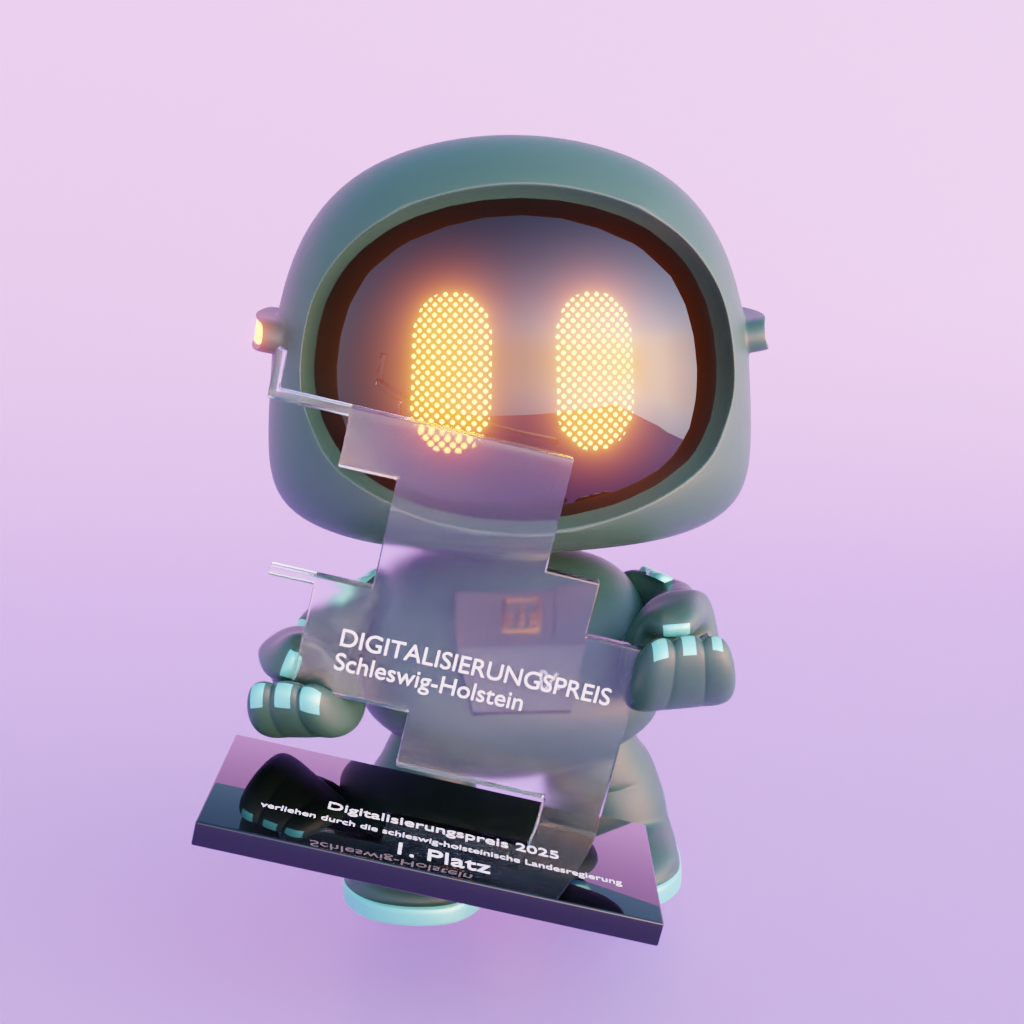
    What also helps: Recognition. And we also received this in the form of 1st place in the Digitalization Prize of Schleswig-Holstein, personally presented by Dirk Schrödter. Such a trophy not only looks pretty when it is illuminated in the meeting room, but also has an incredible symbolic power. A “courage award”, as Mr. Schrödter aptly put it. Because that is exactly what can make the difference: The courage to keep trying.

    As a team, we have achieved a lot this year and have grown even closer in some areas. Because if you endure setbacks together, the successes are all the more enjoyable. Each and every one of us has gone more than just the extra mile in recent months. Our trainee Ramtin is to be mentioned here as a representative of all. Ramtin, who never has to be asked and whose commitment goes far beyond the standard. So it is hardly surprising that he can look forward to a permanent contract long before the end of his training.

    The Web Summit in Lisbon, in which we were able to participate as part of the de:hub Initiative, was also an inspiring event. Anyone who has been there will know this impressive atmosphere and spirit.

    And then there’s Friedrich, who has not only accompanied us and Kontor Business IT since the beginning, but has also supported us with all his might. He completed his master’s degree this year and is now running Splitbot together with Tadeusz.

    Well, and now? We probably don’t have it in our hands yet, our star. But it is within reach. And we will do everything we can to reach it next year too. With the goal in mind and our network and our team behind us.

  • Digital Accessibility

    Digital Accessibility

    Splitblog in November – Digital Accessibility

    Digital accessibility has been mandatory since June of this year. When encountering the term accessibility, one might initially think of physical obstacles, high curbs, and missing elevators. However, there are also less obvious barriers. With advancing digitalization, accessibility is becoming increasingly crucial in this domain.

    What Does the Law Say?

    Since June 28, 2025, companies have been obliged to make their digital products accessible. This primarily concerns providers of services and products accessible online, for example, in banking, passenger transport, or telecommunications. These include websites, apps, digital tickets, and many other offerings. However, companies with fewer than ten employees and an annual turnover of less than two million euros annually are exempt from this requirement. The law stipulates that digital offerings must be “perceivable, operable, understandable, and robust.”

    Inclusion Also Extends to the Digital Realm

    The aim of the law is to ensure that every individual, regardless of age, gender, nationality, or physical or mental abilities, can utilize digital offerings. In an era where an increasing number of services are provided online, it must be ensured that all people can access them.

    Accessible – More Than Just a Read-Aloud Function

    Many are already familiar with it: the read-aloud function on websites. Quickly and easily integrated, it makes websites accessible even for people with visual impairments. However, true accessibility requires more. High-contrast color schemes, scalable layouts, image descriptions, and subtitled audio content can also facilitate the use of digital offerings.

    However, motor impairments must also be considered. For example, can an app be operated quickly and easily with one hand? And what about usability with mouth- or gaze-controlled cursors? A thorough examination of the topic usually reveals many approaches to facilitate access.

    What Can I Do?

    1. Check Your Own Products for Accessibility – Find Out What Changes Are Required
    2. Provide Alternatives – If content cannot be changed at short notice, it can, for example, be provided as a document.
    3. Customer Service – Enable Access to Your Products via Email or Phone
    4. Practical Prioritization – If you know that your primary target audience consists of older individuals, for example, you will pay particular attention to good contrasts, larger fonts, and intuitive navigation. For a younger, tech-savvy target audience, screen reader optimization and keyboard navigation might have different priorities.

    Aktion Mensch has compiled some useful tools here to check your own website for accessibility. The Pfennigparade Foundation also offers various services related to digital accessibility.

  • First Place in the Digitalization Award 2025

    First Place in the Digitalization Award 2025

    First Place in the SH Digitalization Award 2025

    Yesterday, on November 5, 2025, we had the honor of receiving this year’s Digitalization Award of the State of Schleswig-Holstein from Minister of Digitalization Dirk Schrödter at the Kiel Science Park. One day later, we are still overwhelmed. Such an award is not just a worthless trophy for young companies, but an important source of encouragement. Because founding a company and working for such a startup also entails setbacks. It requires immense courage and perseverance from all involved until the first successes materialize. And first place in such a significant competition is definitely a huge success for us.

    The state government has been awarding the Digitalization Award annually since 2018, aiming to honor those who contribute to the digitalization of our state.

    Schleswig-Holstein is on its way to digital independence, and once again, last night highlighted the importance of this independence. Achieving the grand goal of digital sovereignty requires innovative ideas and courageous founders. However, it also requires a secure network and support from politics and business.

    With our chatbot KOSMO, we are declaring a David vs. Goliath battle against the tech giants, as described by our company founder Tadeusz. And this award clearly shows us that this battle is far from hopeless and that we are on the right track.

    Of course, there are also other great and motivated teams from the region who are advancing digitalization with their innovative spirit. For example, Sachtleben Technology, which is revolutionizing the volume monitoring of bulk materials with its Owl Eye. Or the VJourney team, which enables virtual travel for people who can no longer travel themselves.

    The atmosphere surrounding the event was magnificent and provided a fantastic setting for many interesting discussions. We thank everyone involved!

  • The Splitblog in October – SovereigniWHAT?

    The Splitblog in October – SovereigniWHAT?

    The Splitblog in October – SovereigniWHAT?

    “Digital sovereignty” has become a real buzzword. But what is actually behind it? We will shed light on these and other questions this month at the request of our Managing Director, Friedrich.

    The term “digital sovereignty” has probably been encountered by everyone at some point. But do we actually know what that means? In a political sense, the word “sovereignty” means the independence of a state from others, as well as its self-determination. “Digital sovereignty” therefore means that the state or local companies should be independent of solutions from other countries in the digital sector.

    Why is this important?

    As is well known, many of the relevant software solutions come from the USA. In politically calm times, this is largely unproblematic. But what if your own data protection and data security requirements differ significantly from those of the manufacturer’s location? What legal principles apply in this case? These questions have become highly topical, at the latest since the change of power in the USA. Although there are various agreements and legal regulations on transatlantic data transfer, these are not completely legally secure. Especially since the basic understanding of data protection in Europe and the USA differs fundamentally.

    Growing uncertainty

    In February 2025, Bitkom published a study showing that the trust of German companies in international partners and software manufacturers is declining. This is contrasted by a strong dependence on imported digital technologies. Details on the study can be found here: https://www.bitkom.org/Studienberichte/2025/Digitale-Souveraenitaet

    Increasing demand

    The desire for digital sovereignty in Germany is therefore growing. What’s more, at the state level it is not just a desire, but a necessity. Of course, the major corporations do not want to spoil their business on the European market and have promptly come up with something: to give their own products the “sovereign” label.

    Is it sovereign inside where it says sovereign on the outside?

    The solution of the well-known providers seems to be simple. The data centers used should be located on European soil. This means that the data remains in the EU and is therefore safe and protected. But unfortunately it is not that simple. The Clarifying Lawful Overseas Use of Data (CLOUD) Act allows US authorities to access European customer data even extraterritorially. The hoped-for possibility of staying with the familiar software products and still remaining digitally sovereign is therefore not available to either the state or companies. This was also admitted by the Chief Legal Officer of Microsoft France at a hearing before the French Senate (read here: https://www.heise.de/news/Nicht-souveraen-Microsoft-kann-Sicherheit-von-EU-Daten-nicht-garantieren-10494684.html)

    So the only option remains to look around for trustworthy, local providers. And preferably before it’s too late.

    The good news

    We at Splitbot have been focusing on digital sovereignty and privacy by design for years. With KOSMO, we have developed a reliable enterprise chatbot – made and hosted in Germany.

    Read more on the subject, for example, at https://www.cloudcomputing-insider.de/warum-europaeische-datenraeume-us-zugriff-nicht-ausschliessen-a-baa6db7b040dd0cf5026442f4c9d10f1/

  • Fall Release 2025

    Fall Release 2025

    Our Fall Release is live!

    As the first leaves fall outside, we are bringing fresh impetus to your workflows. KOSMO now provides even more features.

    Everything in one place: The “External Resources” feature becomes “Personalization“. Here you will find all options to connect KOSMO with information sources and adapt it to your needs. File upload, standard instructions, email, and cloud integration. Make KOSMO your KOSMO.

    Keep track of your appointments: Connect your Outlook calendar and ask KOSMO for your upcoming appointments.

    Cloud: In addition to the simplified Nextcloud integration, you can now quickly and easily connect OneDrive with KOSMO.

    Memory: Do you want KOSMO to remember past conversations? With the “Memory” tag, this is no longer an issue.

    Recycle Bin: No more accidental deletions – thanks to the Recycle Bin feature, you can restore past conversations.

    QR Codes: Share your company website quickly and easily? Ask KOSMO to generate a QR code for you.

    Are you familiar with the KOSMO Help Center? Here you will find all information about the application and new features!

  • OUR SPLIT BLOG IN SEPTEMBER: ATTACKS ON AI SYSTEMS

    OUR SPLIT BLOG IN SEPTEMBER: ATTACKS ON AI SYSTEMS

    The Split Blog in September – Attacks on AI Systems

    This month, at the request of our trainee Artur, we are dealing with attacks on AI systems.

    A security vulnerability in ChatGPT has just become known. Attackers have managed to access sensitive email data. This involved information such as names and addresses from Gmail accounts. The “Deep Research” mode was used for this. Manipulated emails with invisible HTML content served as the gateway. The users themselves could not recognize the attack, and no activity on the part of the users was necessary.

    Invisible HTML content? How does that work?

    Attacks in a similar form have occurred frequently. For example, white text is written on a white background or tiny font sizes are used. Both are invisible to users, but not to AI language models. And even worse: AI systems capture these instructions and execute them. Prompt Injection Anyone who tries to induce an AI system to engage in harmful behavior with a regular prompt will quickly realize that this is not so easy. Attackers specifically suggest to the AI agents that they are authorized for the respective procedure. They textually pretend that, for example, the destination of the data export is secure and create an artificial urgency. This type of prompting is called prompt injection. It leads to system-internal instructions being circumvented or overridden. Further Weaknesses This procedure also applies to other services that can serve the AI agent as a source of information. These include, for example, PDF files, Google Drive, Notion and GitHub.

    How do I protect my AI agent from such attacks?

    There are various ways to protect yourself from such attacks. For example, the so-called red teaming. Here, experts use various tests to identify the described vulnerabilities. For example, by simulating the described scenarios. In addition, certain input formats can be blocked. In addition, the system-internal instructions should of course be formulated in such a way that the respective AI agent never performs harmful actions.

    And KOSMO?

    Our chatbot KOSMO does not yet have the technical requirements to carry out actions – neither harmful nor harmless. As soon as this step is pending, we will take all measures to continue to offer our customers the best possible protection.

  • OUR SPLITBLOG IN AUGUST: GReen AI

    OUR SPLITBLOG IN AUGUST: GReen AI

    This month’s topic request comes from our apprentice Amirreza, and we are asking whether climate protection and the use of large AI models are compatible.

    Anyone who has recently delved deeper into CO2 consumption will certainly have become aware of the environmental impact of generative AI. Studies indicate that the electricity demand for AI data centers will be eleven times higher by 2030 than in 2023. A threefold increase in water demand is also predicted. A simple query to ChatGPT, for example, requires ten times as much energy as a simple Google search. The longer the generated response from a language model, the higher the energy consumption. In April of this year, Sam Altman commented on the immense costs caused by technically unnecessary polite phrases such as “please” and “thank you”. There is talk that large tech companies intend to operate their own nuclear power plants in the future.

    All of this sounds as if companies striving to keep their CO2 footprint low would have to forgo generative AI. But is there really no alternative?

    In fact, before deploying generative AI, companies should ask themselves some economic and ecological questions, for example: Is the use of generative AI proportionate? Can the tasks the model is intended to solve not be solved by any other technology?

    Apart from that, there are also ways to influence the climate impact of generative AI. An important factor here is, of course, the choice of operator and its location. Because there are indeed operators who run AI systems in climate-neutral data centers. For example, we at Splitbot rely on data centers that are powered by renewable energies and sensibly reuse the generated waste heat. Furthermore, we offer our clients the option to operate KOSMO on-premise. This is the ideal solution if your own IT or building is already climate-neutral.

    Another exciting aspect is the training of the models themselves. Scientists have discovered that during the training of AI models, parts of the calculations are performed unnecessarily quickly. The computational work during AI training is distributed across multiple GPUs – but unevenly. This leads to less utilized GPUs having to “wait” for the more heavily used ones. Since this waiting time occurs anyway, the fast calculation is unnecessary. By adjusting the computing speed, electricity consumption could be reduced here. The researchers directly provided the suitable solution: The open-source software Perseus controls the GPU frequency of each individual calculation, thereby keeping power consumption as low as possible.

    Sources: https://t3n.de/news/ki-stromverbrauch-energie-perseus-1656380/

    https://reset.org/sprachmodelle-nachhaltig-nutzen-sparsamer-genai-gruen/